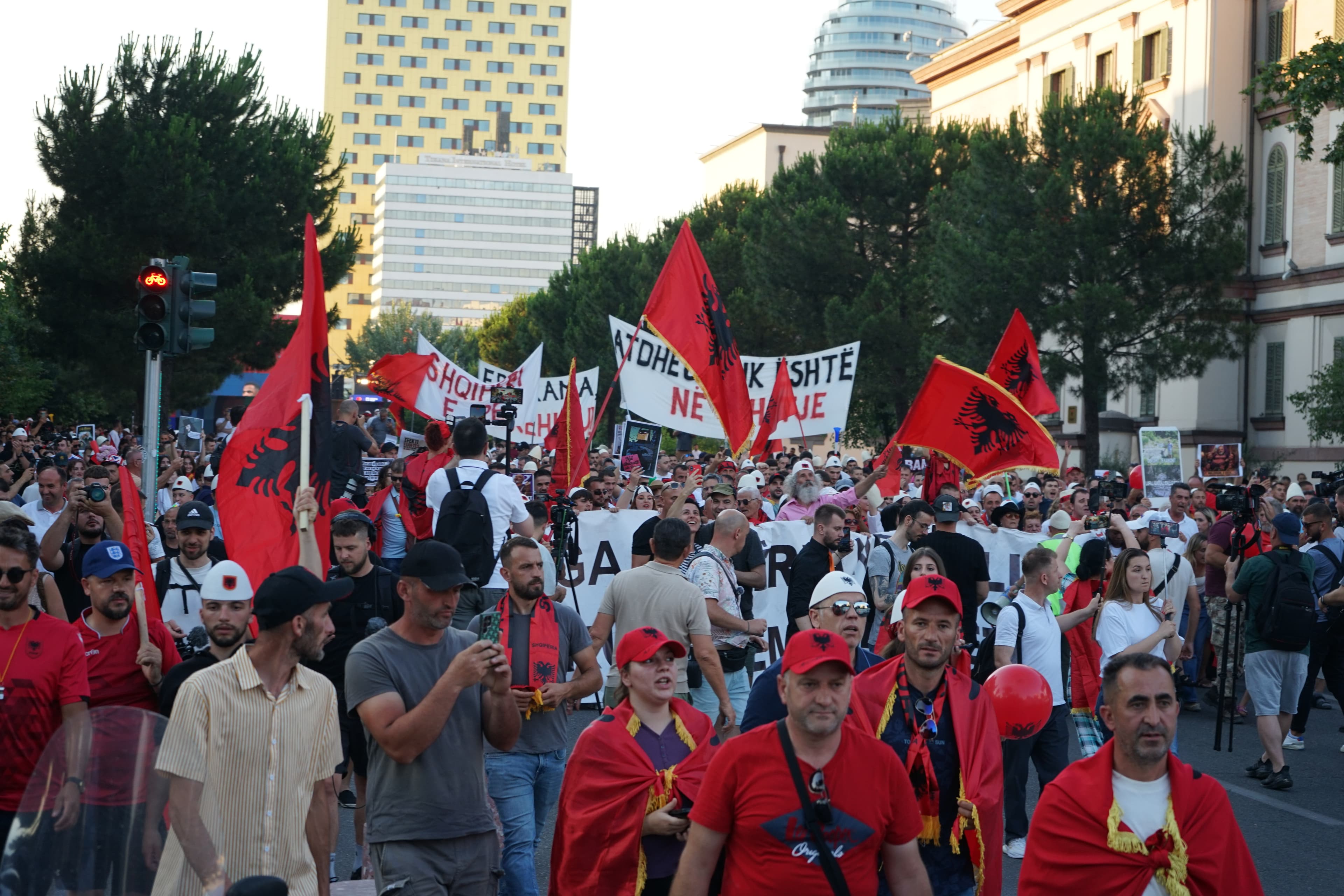
Albania's daily protests reached their 100th day on 7 September 2026, and what started as a fight over one stretch of coast is now mostly about money. Wages, pensions, rent, and the price of a weekly shop.
For anyone running an Albanian business, or sending money home from London, Detroit or Athens, that shift matters more than the politics.
What actually happened
The dispute started at the coast. In mid-May 2026, residents and environmental campaigners began protesting at Pishe Poro, near the Narta Lagoon in the Vlore region, where fencing and access roads had gone in for a luxury tourism development. The Sazan Island side of the project was reported by Reuters in January 2025 as an agreement worth around 1.4 billion dollars with an affiliate of Affinity Partners, the investment firm founded by Jared Kushner.
The turning point was 30 May. At a demonstration near the Portonovo site, private security personnel dragged a protester across the sand while police stood by without intervening. The footage spread within hours.
The next evening, 31 May, the protest moved to Tirana and became daily. It has been daily ever since, gathering in Skanderbeg Square and marching past the prime minister's office. Protesters carried signs showing the flamingos that feed in the protected wetland, and the movement took the name it still uses: the Flamingo Revolution.
It did not stay about flamingos. Within weeks the crowds were chanting about hospitals, pensions, wages and rent. The largest single march, on 20 June, was put at more than 250,000 people by Albanian media. By its 100th day it was the longest protest of its size recorded in Albania, according to Citizens.al. It has no single leader, and people turn up for different reasons.
It also did not stay in Tirana. Demonstrations have been held in Durres, Vlore, Korce, Elbasan, Kukes, Shkoder, Gjirokaster and Lezhe, in Kosovo, and in Albanian diaspora communities abroad.
On 8 September, the day after the 100th, parliament returned from its summer recess. Police blocked marchers from reaching the building in central Tirana and the day turned violent, with protesters throwing eggs and tomatoes at officers in riot gear. The Associated Press reported the clashes the same day.
The gap the numbers show
The phrase doing the rounds in Albanian commentary is European prices, Balkan salaries. The official figures show why it lands.
What | Figure | Source |
|---|---|---|
Average gross monthly wage, Q2 2026 | 92,150 leke, up 9.8% on a year earlier | INSTAT |
Inflation, July 2026 | 3.4% | INSTAT, harmonised index |
Food and non-alcoholic drinks | up 3.2%, the single biggest contributor | INSTAT |
Restaurants and accommodation | up 3.6% | INSTAT |
Transport | up 4.6% | INSTAT |
All INSTAT figures checked 12 September 2026.
On paper that looks like wages beating prices, and for people in work, they have been. The average monthly wage roughly doubled in euro terms between early 2021 and the end of 2025, from about 454 euro to about 900 euro, on figures compiled by the German Economic Team from INSTAT data.
Pensioners are a different story, and it is the sharper one.
The average pension was worth about 30% of the average salary last year, down from 38% in 2021. Wages rose 47% between 2021 and 2025. Pensions rose 16%, because they are only indexed to inflation. Around 55% of Albania's 641,085 pensioners receive a partial pension, averaging 13,500 leke a month.
So the country has had real wage growth and a real pensions squeeze at the same time. Both things are true, and which one you feel depends entirely on whether you are still working.
One protester, quoted by hashtag.al on 9 September, put the everyday version of it: "We are all affected by the prices, which are 3 to 10 times more expensive than in Europe." That is a claim made at a protest, not a measured figure, and the official inflation numbers above do not support it as stated. But the frustration behind it is not invented, and the pension figures show where it comes from.
What this means if you run an Albanian business
A cost of living squeeze hits a small business from both ends at once. Your costs go up, and your customers have less to spend. Restaurants and accommodation are carrying 3.6% annual price growth, which sounds modest until it lands on a menu that regulars know by heart.
Three things are worth watching.
Pensioner customers are the first to go. If more than half the country's pensioners are living on 13,500 leke a month, discretionary spending in that group is close to gone. Any business whose regulars skew older is already feeling it.
Tourism money and local money are not the same money. A business on the coast serving visitors and a business in a residential neighbourhood serving locals are in different economies right now, even in the same town.
Young customers and young staff are leaving. INSTAT recorded 166,400 more people leaving Albania than returning between 2021 and 2025, and most of them were young. That is both a shrinking customer base and a hiring problem.
What this means if you are in the diaspora
If you send money home, you are not watching this from the outside. You are part of the economy being argued about.
Albanians abroad sent 1.9 billion euro home in 2025, about 6.9% of Albania's entire economy, on Bank of Albania figures compiled by the German Economic Team. Where it comes from:
Country | Share of remittances |
|---|---|
Italy | 38% |
Greece | 32% |
United States | 8% |
Germany | 7% |
North Macedonia | 4% |
Everywhere else | 11% |
Two countries send seven euro in every ten.
That money does something specific in a cost of living squeeze: it goes to the people the wage figures do not cover. Pensioners, people between jobs, families whose income has not moved with prices. The pension gap above is, in practice, partly filled by the diaspora.
It also explains something visitors notice and often misread. If you come back in August and the prices in a coastal restaurant feel like Italy, that is not only tourism. It is a genuine gap between what things cost and what most people locally are paid.
Is it safe to visit Albania right now?
The protests are concentrated in central Tirana, around Skanderbeg Square, Deshmoret e Kombit Boulevard and the parliament building, and they have been overwhelmingly peaceful across more than 100 days. The violence on 8 September was an exception, reported precisely because it was one.
Check current advice from your own government before travelling, and avoid the boulevard when a march is on. That is the honest answer, not a reassurance.
Where this goes next
Protesters are now asking for things a resort decision cannot settle: the prime minister's resignation, constitutional reform, and more transparency in how public land is handed out. The government frames the opposition as obstruction. Neither side looks close to moving.
For businesses, the practical question is not who wins the argument. It is whether the cost of living gap closes, and nothing in the current figures suggests it closes quickly.
Figures in this article come from INSTAT, Albania's official statistics office, and from Bank of Albania data compiled by the German Economic Team. All checked 12 September 2026. Reporting on the protests is from the Associated Press, Reuters, DW, Citizens.al and hashtag.al. Photograph by Albinfo, CC BY 4.0, via Wikimedia Commons.
Albanian Directory is a business directory, not a political organisation. We report what is happening and what it means for Albanian businesses and the community. We do not take political sides.